Why Cable Materials Matter
Cables are the unsung heroes of any Hi-Fi setup — quietly shaping tone, rhythm, and emotion. While electronics and speakers often steal the spotlight, your speaker and interconnect cables determine how efficiently the audio signal travels between them.
Every conductor, insulation, and connector introduces a measurable (and audible) influence on the signal. The goal is simple: transmit music as purely as possible, without loss or added coloration. But how different materials achieve this is where things get interesting.
Copper — The Warm, Natural Performer
Copper remains the most widely used conductor for one reason: balance. It’s affordable, extremely conductive, and delivers a sound many describe as warm, full-bodied, and musical.
However, not all copper is equal. Manufacturers refine copper to different purities — such as Oxygen-Free Copper (OFC) or Long-Grain Copper (LGC) — to minimize impurities that distort signal flow.
Examples:
- AudioQuest Rocket 44 — features Long-Grain Copper conductors for smooth mids and tight bass.
- Van den Hul Clearwater — uses high-purity, silver-coated copper for a touch of extra sparkle.
- Kimber Kable 4PR — a classic braided copper design known for rhythmic precision.
Copper cables are ideal for systems that sound lean or analytical, offering warmth and density without dulling detail. In essence, copper “connects the dots” between clarity and musicality.
Silver — The Detail and Dynamics Specialist
For those who crave transparency and speed, silver is the conductor of choice. With slightly higher conductivity than copper, silver cables often sound more open, dynamic, and extended in the treble. They reveal micro-details like room ambience, cymbal shimmer, and vocal breath.
However, silver’s revealing nature can expose harshness in poorly matched systems — making it best paired with tube amps or warm speakers.
Examples:
- Chord Signature XL — pure silver-plated copper that adds airiness without straying into brightness.
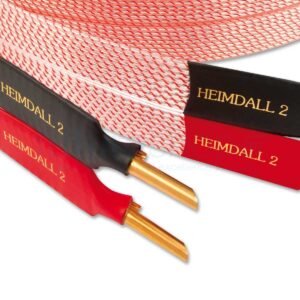
- Nordost Heimdall 2 — solid-core silver-plated conductors for speed, imaging, and clarity.
-
Siltech Classic Legend 680i — uses proprietary silver-gold alloy conductors for rich, controlled tonality.
Silver cables excel in setups that already sound balanced but could benefit from extra definition and spatial depth. They bring music alive with sparkle and immediacy.
Gold, Palladium & Hybrid Designs — The Luxury Refinements
Enter the realm of exotic metallurgy, where artistry meets engineering. Manufacturers experiment with gold, palladium, or silver-copper hybrids to achieve unique tonal balances and improved longevity.
Gold and palladium don’t oxidize, ensuring long-term stability and smoother treble textures. Hybrids blend the strengths of multiple metals — copper’s warmth with silver’s clarity — for a refined, natural sound.
Examples:
- Siltech Royal Signature Series — silver-gold alloy for silky highs and holographic imaging.
- Cardas Clear Beyond — uses hybrid copper formulations with patented golden-ratio stranding for coherence.
While pricey, these designs appeal to audiophiles seeking the last 5% of sonic perfection — smoother harmonics, quieter backgrounds, and an almost liquid sense of flow.
Geometry and Shielding: The Unsung Heroes
Beyond materials, the construction of a cable often defines its character.
- Geometry: Braided, twisted, or solid-core layouts affect capacitance and electromagnetic fields. For instance, Kimber Kable’s weave minimizes noise, while Nordost’s flat-ribbon geometry lowers inductance for faster transient response.
- Shielding: Essential for rejecting radio-frequency (RF) and electromagnetic interference (EMI), especially in urban environments or digital systems.
- Dielectrics (Insulation): Materials like Teflon, polyethylene, or air tubes reduce signal loss and dielectric absorption, preserving transient speed and tonal balance.
Well-designed geometry can make a humble copper cable outperform a poorly constructed silver one. Engineering precision matters as much as metallurgy.
Matching Cables to Your System
The right cable complements your system’s character — it doesn’t fix flaws. Bright systems benefit from warm copper; darker systems shine with silver or hybrids. For best results:
- Trust your ears, not just specs.
- Avoid bottlenecks. Pair similar quality levels across your interconnects, speaker cables, and power cords.
- Audition before buying. Small changes in your system chain can make big differences in tonal synergy.
And remember: the goal isn’t to colour the sound — it’s to connect you to the music.
Final Thoughts
In the world of Hi-Fi, cable materials are equal parts science and artistry. Copper grounds the sound in warmth, silver elevates it with clarity, and hybrids polish it to perfection. Ultimately, the “best” cable isn’t the most expensive — it’s the one that lets your system breathe, your music sing, and your soul connect.