-
SOULNOTE A-3 Reference Integrated Amplifier
• Overview – SOULNOTE A-3 Reference Integrated Amplifier, released in 2021, is a solid-state Class AB integrated design without DAC or phono, engineered for ultimate signal purity and unrestricted current delivery.
• Circuit Philosophy – Built around SoulNote’s zero-feedback, non-parallel architecture, the amplifier prioritises instantaneous current response, wide bandwidth, and natural harmonic flow, appealing strongly to purist audiophiles.
• Sonic Character – SOULNOTE A-3 Reference Integrated Amplifier delivers exceptional dynamic contrast, dense tonal colour, and expansive soundstage depth, excelling with difficult loudspeaker loads and revealing high-resolution source components.
• Specifications – Rated at approximately 120 W per channel into 8 ohms and 240 W into 4 ohms, with ultra-high current capability, wide frequency response, and discrete output devices optimised for low impedance control.
For Prices LoginSOULNOTE A-3 Reference Integrated Amplifier
For Prices Login -
Soulnote P-3 Preamplifier
• Overview – The Soulnote P-3 Preamplifier, released in 2022, is a reference solid-state preamplifier featuring a fully balanced, non-negative-feedback analogue design engineered to deliver exceptional transparency and musical realism.
• Zero-Feedback Architecture – Employing Soulnote’s proprietary non-negative-feedback circuit topology, the Soulnote P-3 Preamplifier preserves transient accuracy, harmonic integrity, and dynamic expression while maintaining an exceptionally low noise floor.
• Reference-Level Engineering – The Soulnote P-3 Preamplifier features dual-mono construction, discrete analogue circuitry, and mechanically isolated assemblies, delivering expansive soundstaging, precise imaging, and outstanding channel separation for flagship audio systems.
Type-R circuits are used inside the non-NFB balance amplifier
The output line amplifier uses Type-R discrete non-NFB balance circuits that have been finely tuned for preamplifier use. It also includes the newly-developed super high-quality naked foil resistors. With 1ohm emitter resistors and 3.9ohm output resistance, it delivers astonishing information detail and S/N presence for superior power preamplifier drive capabilities.
High-end resistance switching method audio volume control circuit
The best possible methods and the highest-quality parts create the best audio volume control. All the resistors in this unit are ultra high-quality, naked foil resistors. The switching relays also use the newly developed RSR-2-12D (Reference SOULNOTE Relay) ultralow loss custom relay. Volume control is configured with 144 steps in 0.5 dB intervals. Vibrancy and sound quality remain unaffected, even when lowering the volume.
RSR-2-12D (Reference SOULNOTE Relay)
An ultra-low loss glass tube sealed reed relay that performs similar to a mercury relay as a base has been further customized. This is an original custom relay created by SOULNOTE that can reach sound quality levels comparable to that of wire. Each P-3 contains 94 of these relays.
For Prices LoginSoulnote P-3 Preamplifier
For Prices Login -
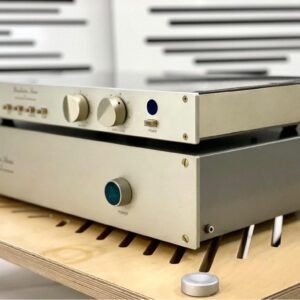
FM Acoustics 245 Pre Amp and F10B Power Amp
• Overview – FM Acoustics 245 Pre Amp and F10B Power Amp, released circa 1995, form a reference-grade solid-state amplification system focused on extreme linearity, ultra-low noise, and uncompromising signal purity.
• Preamplifier Design – The FM Acoustics 245 preamplifier is engineered for absolute transparency, offering exceptional channel separation, precision volume control, and vanishingly low distortion for the most revealing analog and digital sources.
• Power Amplification – Designed for stability and control, the pairing delivers effortless dynamics, tight bass authority, and a neutral tonal balance, allowing loudspeakers to perform without coloration or compression at any listening level.
• Specifications – F10B delivers approximately 250 watts per channel into 8 ohms, doubling into lower impedances, with extremely low THD, wide bandwidth, high damping factor, and fully discrete, DC-coupled circuit topology.
• Dimensions – FM Acoustics 245 Pre Amp and F10B Power Amp: Preamp approx. 445 mm (W) × 140 mm (H) × 430 mm (D); power amplifier approx. 445 mm (W) × 260 mm (H) × 520 mm (D), designed for professional-grade rack integration.
• Weight – Preamp approximately 20 kg; power amplifier approximately 75 kg, reflecting massive power supplies, extensive shielding, and precision-machined chassis construction essential to FM Acoustics’ reference performance standards.
For Prices LoginFM Acoustics 245 Pre Amp and F10B Power Amp
For Prices Login -

Mark Levinson No.53 Reference Monoblock
• Product Overview – Mark Levinson No.53 Reference Monoblock, released in 2009, is a solid-state Class D reference amplifier using proprietary PWM switching architecture, delivering extreme power, efficiency, and absolute control over demanding loudspeakers.
• Reference Engineering – Designed as a no-compromise statement, the amplifier employs separate digital control, analog audio, and power sections, ensuring ultra-low noise, massive current delivery, and exceptional stability under real-world loads.
• Sound Performance – Renowned for its effortless dynamics, expansive soundstage, and iron-fisted bass control, the Mark Levinson No.53 Reference Monoblock combines transparency with authority rarely achieved in high-power amplification.
• Specifications – Rated at 500 W into 8 ohms, 1000 W into 4 ohms, with stable operation into 2 ohms, ultra-wide bandwidth, low distortion, and advanced thermal and protection monitoring systems.
• Dimensions – Each chassis measures approximately 483 mm (W) × 241 mm (H) × 610 mm (D), featuring substantial heatsinking and an industrial-grade enclosure engineered for long-term reference operation.
• Weight – Each monoblock weighs approximately 61 kg, reflecting its massive power supply, high-density construction, and mechanical rigidity essential for vibration control and electrical stability.
For Prices LoginMark Levinson No.53 Reference Monoblock
For Prices Login -
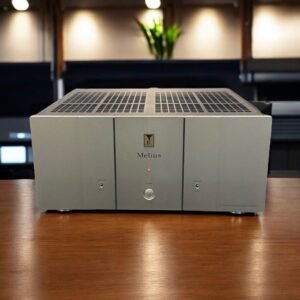
Kondo Melius Power Amplifier
Specifications
• Type: Vacuum Tube Power Amplifier
• Output Power: 50W per channel (Class A, push-pull)
• Tubes: 4 × 6550 / KT88, 2 × 12AU7, 2 × 12AX7
• Frequency Response: 10Hz – 100kHz (±1dB)
• Input Impedance: 100kΩ
• Output Impedance: 4Ω / 8Ω
• Dimensions: 460 × 280 × 390 mm
• Weight: 35 kg
• Made in Japan
For Prices LoginKondo Melius Power Amplifier
For Prices Login -

Gryphon Essence Monoblock
• Product Overview – The Gryphon Essence Monoblock, a reference pure Class A power amplifier, delivers up to 220 W into 2 Ω per monoblock with zero negative feedback and extreme current reserves for demanding loudspeakers.
• Circuit & Topology – Gryphon Essence Monoblock, uses true dual-mono construction, independent driver and output power supplies, and high-current bipolar devices per monoblock, the amplifier offers ultra-low distortion, effortless transient authority, and deep control.
• Sonic Character – Known for exceptional neutrality, textural purity, and dynamic ease, the Essence Monoblock emphasises life-like midrange, detailed imaging, and low distortion across complex musical passages regardless of volume.
• Specifications – Rated at approx. 55 W into 8 Ω, 110 W into 4 Ω, and 220 W into 2 Ω with bandwidth to 350 kHz (-3 dB), extremely low output impedance (~0.0075 Ω), and a massive 880,000 µF power bank per unit.
• Dimensions – Each monoblock measures approximately 470 mm (W) × 240 mm (H) × 460 mm (D), embodying a substantial, precision-engineered chassis that supports thermal management and vibration resistance.
• Weight – Each amplifier weighs roughly 45 kg (99 lb), reflecting high-mass toroidal transformers, extensive capacitor banks, and rugged construction for optimal electrical stability and long-term performance.
For Prices LoginGryphon Essence Monoblock
For Prices Login -

Pass Labs XS Phono with Power Supply
-
Pass Labs XS Phono with Power Supply – This flagship dual-chassis phono preamplifier from Pass Laboratories raises the vinyl benchmark, enabling ultra-low-noise amplification of MC/MM cartridges with absolute authority and tonal purity.
-
Reference-Grade Audio Architecture – Featuring selectable gain settings (56, 66, 76 dB), RIAA accuracy ±0.1 dB from 20 Hz to 20 kHz, and a purpose-built power supply dedicated to quiet signal handling.
-
System Integration & Specification – Dual-chassis design: each unit measures approximately 19″ W × 14″ D × 6.25″ H (483 × 356 × 159 mm) and consumes around 55 W of power—ideal for serious turn-table setups.
-
Build Quality & Weight Profile – Weighing roughly 80 lbs (≈ 36 kg total), the unit’s heavy, stable construction minimizes mechanical and electrical interference for fine-detail retrieval and low-level resolution.
For Prices LoginPass Labs XS Phono with Power Supply
For Prices Login -
-
Aavik U-588 Unity
• Aavik U-588 Unity Overview – The Aavik U-588 Unity, introduced in the late 2010s, is a flagship Class D solid-state integrated amplifier with premium DAC functionality, offering exceptional musical resolution, ultra-low noise, and stunning dynamic power.
• Advanced Noise-Reduction & Resonance Control – Built with Aavik’s Tesla coil noise-suppression system, dither circuitry, and resonance-optimized chassis design, the Aavik U-588 Unity delivers remarkable clarity, microdynamic precision, and tonal purity across all sources.
• High-Current Class D Authority – The Aavik U-588 Unity features massive current reserves, lightning-fast transient response, and exceptional speaker control, enabling effortless handling of complex music passages at realistic listening levels.
• Premium DAC and Connectivity – Integrated with Aavik’s high-end digital architecture, the U-588 provides ultra-clean digital conversion, low-jitter performance, and flexible input options ideal for modern streaming and high-resolution playback systems.
• Dimensions – Approx. 102 mm (H) × 384 mm (W) × 400 mm (D), with a low-profile yet substantial chassis designed to minimize vibration and enhance electrical stability.
• Weight – Around 12 kg, reflecting its heavy shielding, robust power supply, and resonance-controlled construction.
For Prices LoginAavik U-588 Unity
For Prices Login -
Soulnote M-3X Monoblock
• Overview – The Soulnote M-3X Monoblock, released in 2022, is a solid-state Class AB monoblock power amplifier engineered with Soulnote’s zero-negative-feedback philosophy to deliver reference-level dynamics, transparency, and musical realism.
• Zero-Feedback Circuitry – Employing Soulnote’s proprietary non-negative feedback topology, the Soulnote M-3X Monoblock preserves transient speed, harmonic integrity, and dynamic expression while maintaining exceptional control over demanding loudspeaker loads.
• Reference Mono Architecture – The Soulnote M-3X Monoblock features true monaural construction, oversized linear power supplies, mechanically isolated circuitry, and premium discrete components for outstanding channel separation and effortless musical presentation.
An enhanced current version of the M-3
We have been able to double the current delivery capacity without compromising the spatial expression or penetrating power of the single push, achieving in that way both delicate expression and overwhelming power.
Newly developed transistor pairing method
We have developed a new precise pairing method to match the fluctuation rate of hfe (current amplification factor), which consistently changes on the time axis due to transistor current changes during music playback. This method involves inputting hfe measurement data for a large number of transistors at various current values, calculating the Euclidean distance for all combinations, and then selecting transistor pairs that are within the standard value (a level that can be called identical if measurement errors are taken into account). Doing so has enabled us to achieve a “blur-free parallel push-pull” comparable to a single push-pull. The output stage transistors are a pair of industrial TO3 (metal can), the same type used in the M-3. The driver stage also incorporates the TO3P transistors to easily drive these two TO3 transistors for a total of four Darlington construction stages.
For Prices LoginSoulnote M-3X Monoblock
For Prices Login -

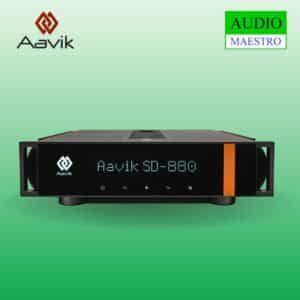
Aavik I-880 Integrated Amplifier
• Overview – Aavik I-880 Integrated Amplifier, released in 2021, is a high-power solid-state Class D integrated amplifier featuring advanced DAC and phono capabilities, engineered for extreme resolution and low-noise performance.
• Sound Performance – Designed for absolute transparency, the amplifier delivers explosive dynamics, ultra-low noise floor, and exceptional control, presenting music with speed, scale, and natural tonal balance across complex passages.
• Design Philosophy – Built using Aavik’s resonance-control technologies and minimalist signal paths, the Aavik I-880 Integrated Amplifier emphasizes mechanical grounding and vibration reduction to preserve microdetail and spatial accuracy.
• Specifications – Rated at approximately 300 watts per channel into 8 ohms and 600 watts into 4 ohms, offering extremely high damping factor, wide bandwidth, and stable operation with demanding loudspeaker loads.
• Dimensions – Chassis measures approximately 442 mm (W) × 147 mm (H) × 460 mm (D), providing a substantial yet refined footprint suitable for high-end audio racks.
• Weight – The amplifier weighs approximately 42 kg, reflecting its massive power supply, resonance-controlled enclosure, and premium internal construction for thermal stability and sonic consistency.
For Prices LoginAavik I-880 Integrated Amplifier
For Prices Login -
Aavik Acoustics I-880 Integrated Amplifier
• Overview – The Aavik Acoustics I-880 Integrated Amplifier, released in 2021, is a flagship solid-state Class A integrated amplifier featuring an integrated DAC and network streaming platform, delivering uncompromising reference-level performance from a single chassis.
• Ultimate All-in-One Performance – The Aavik Acoustics I-880 Integrated Amplifier combines high-resolution streaming, premium digital conversion, and fully balanced analogue circuitry, producing expansive imaging, outstanding transparency, and exceptional musical realism.
Aavik 200W pure class A amplifier
Aavik have designed a circuitry that constantly keeps the bias spread 0,63 V above the required current, no matter where it is in the cycle. So, no matter how much current the power amp requires to perform, it always stays in Class A up to an impressive 2×200 W into 8 ohms, while at the same time not consuming unnecessary power.
This significant reduction in the power requirements of the amplifier allowed Aavik to design the capacitors as smaller units and place them locally, so that essentially each of the eight pairs of output transistors has its own capacitor bank right next to it. This means that the current does not have to flow through long wire harnesses and long circuit boards. The current is always directly at the output transistor, which means a shorter signal path and therefore less noise. In addition, this innovative Aavik design also means that the 880 amplifiers do not get as hot as conventional Class A amplifiers, resulting in higher efficiency.
Resonant mode power supply
This Aavik series is designed to ensure massive power resources with ultra-low noise. Unlike the square waves used by conventional switch mode power supplies, this Aavik series boast a resonant mode design which is principally driven by sine waves.
When more power is needed, the operating frequency increases, which, in turn, has the advantage that the power density also increases, thus allowing higher peak power when required by the music.
The 880 cabinet design
A study of materials and shapes. The exterior design of the Aavik 880 amplifier is the result of Flemming Erik Rasmussen’s artistic and aesthetic work. However, his design philosophy is and always has been that design must serve purpose. The cabinet of the Aavik 880 amplifier was designed primarily with the goal of maintaining the best audio characteristics of the electrical design, i.e. the lowest inductance, reducing hysteresis to an absolute minimum, and ensuring excellent resonance control. In addition, since this was a Class A amplifier that was to be developed, there were some predefined premises for the design. With these goals in mind, the design process became a study of shapes and materials that opened up a unique and constructive synergy between Flemming Erik Rasmussen and Michael Børresen.
For Prices LoginAavik Acoustics I-880 Integrated Amplifier
For Prices Login