-
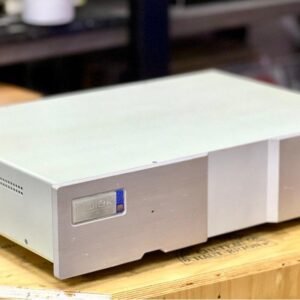
Isotek Sigma Power Conditioner
• Overview – The Isotek Sigma Power Conditioner, released in 2015, is a solid-state mains conditioning component engineered to dramatically reduce electrical noise while maintaining unrestricted current delivery for high-performance audio systems.
• Power Architecture – Built around IsoTek’s advanced delta-filtering topology, the Isotek Sigma Power Conditioner isolates connected components, eliminating differential and common-mode noise while preventing cross-contamination between digital sources and high-current amplifiers.
• Sonic Performance – By lowering the system noise floor, the Isotek Sigma Power Conditioner improves bass articulation, dynamic contrast, image stability, and low-level resolution, especially noticeable in revealing reference-grade analogue and digital systems.
• Specifications – Rated for high-current audio use, featuring multiple individually filtered outlets, star-earthed grounding, internal copper bus bars, RFI/EMI suppression, and surge protection without dynamic compression or current limiting.
• Dimensions – Measures approximately 445 mm (W) × 150 mm (H) × 350 mm (D), designed for standard hi-fi racks while allowing sufficient ventilation and cable clearance for complex multi-component installations.
• Weight – Weighs roughly 15 kg, reflecting substantial internal filtering networks, shielding, and mechanical damping that contribute to stable, resonance-free operation and long-term electrical reliability.
For Prices LoginIsotek Sigma Power Conditioner
For Prices Login -

Isotek Evo3 Power Conditioner
• Product Overview – The Isotek Evo3 Power Conditioner (2016) is a solid-state mains conditioning solution designed to reduce electrical noise, improve current delivery, and enhance overall system clarity in high-resolution hi-fi setups.
• Filtering Topology – Employing IsoTek’s multi-stage delta filter network, the Isotek Evo3 Power Conditioner effectively removes both common-mode and differential-mode noise while preventing cross-contamination between connected audio components.
• Sonic Improvements – Users typically experience lower noise floor, improved micro-detail, tighter bass control, and greater soundstage depth, especially when used with sensitive digital sources and analogue front-end components.
• Specifications – Features high-current audio outlets, internal copper bus bars, star-earthed grounding, RFI/EMI suppression, and surge protection, all engineered to avoid current compression and preserve amplifier dynamics.
• Dimensions – Measures approximately 445 mm wide × 90 mm high × 305 mm deep, sized to integrate easily into standard hi-fi racks or equipment shelves without compromising ventilation or cable management.
• Weight – Weighs roughly 8 kg, reflecting robust internal filtering components, shielding, and mechanical construction designed to ensure stability, durability, and long-term performance consistency.
For Prices LoginIsotek Evo3 Power Conditioner
For Prices Login -

Apogee Stage Speakers
• Product Overview – The Apogee Stage Speakers, released circa 1990, are full-range planar ribbon loudspeakers designed for high-resolution, low-distortion playback, delivering the open, fast transient response Apogee is renowned for.
• Ribbon Loudspeaker Performance – Featuring true ribbon midrange and tweeter elements, these speakers deliver lightning-fast transients, exceptional clarity, and expansive soundstaging that rewards high-quality amplification and careful system matching.
• Design & Sonic Character – The Apogee Stage Speakers use a dipole radiation pattern with large ribbon surfaces, producing natural tonal balance, deep image layering, and lifelike vocal reproduction unmatched by conventional dynamic driver designs.
• Specifications – Nominal impedance is approximately 3–4 ohms with sensitivity around 86 dB, requiring high-current amplifiers capable of stable low-impedance drive to unlock their full dynamic and tonal potential.
• Dimensions – Each speaker measures approximately 1220 mm (H) × 560 mm (W) × 60 mm (D), with a slim vertical profile that still demands adequate floor space and thoughtful room placement.
• Weight – Each speaker weighs roughly 32 kg, reflecting the substantial ribbon assemblies, rigid frame construction, and damping required for mechanical stability and accurate ribbon driver operation.
For Prices LoginApogee Stage Speakers
For Prices Login -
Tannoy Yorkminster SE Prestige
Tannoy Yorkminster SE Prestige
Enclosure Type: 2-way twin rear-ported
• Recommended Amplifier: 50 – 225W
• Power Handling: 150W
• Frequency Response: 23Hz – 22kHz
• Crossover Frequency: 1.1kHz
• Crossover Type: Bi-wired, hand-wired passive, time-compensated 2nd order LF & HF
• Sensitivity: 95dB
• Impedance: 8 Ohms
• Internal Volume: 200 Litres
• HF: 51mm (2”) aluminium alloy dome, Alnico magnet, Pepperpot Waveguide™
• LF: 300mm (12”) treated paper pulp cone, HE twin-roll fabric surround, 52mm (2”) voice coil
• Adjustments: ±3dB over 1kHz to 22kHz, +2dB to –6dB per octave (5kHz – 22kHz slope)
• Dimensions (W x H x D): 620 × 1080 × 447 mm
• Weight: 61.5kg each
For Prices LoginTannoy Yorkminster SE Prestige
For Prices Login -
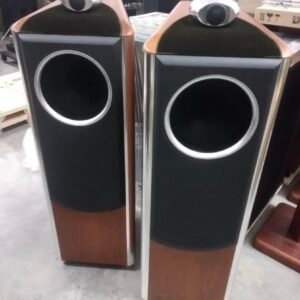
Tannoy TD10
• Classic Dual Concentric Design – Tannoy TD10, released in the mid-1990s, features the renowned Dual Concentric driver, delivering point-source coherence, precise imaging, and natural tonal balance prized by experienced audiophiles.
• Coherent Soundstage Performance – The Tannoy TD10 excels in phase accuracy and timing, producing a holographic stereo image with stable center focus, realistic scale, and effortless musical flow across diverse listening genres.
• High Sensitivity Efficiency – Designed for compatibility with both tube and solid-state amplification, this loudspeaker offers high sensitivity and controlled impedance, allowing dynamic expression even with moderate-powered amplifiers.
• Specifications – Nominal impedance is 8 ohms with sensitivity around 92 dB, using a 10-inch Dual Concentric driver, wide frequency response, and front-ported cabinet for controlled low-frequency extension.
• Dimensions – Approx. 1,000 mm (H) × 360 mm (W) × 340 mm (D), providing a substantial cabinet volume optimized for bass authority while remaining suitable for medium to large listening rooms.
• Weight – Each speaker weighs approximately 32–35 kg, reflecting robust cabinet construction designed to minimize resonance and support stable, vibration-free driver performance.
For Prices LoginTannoy TD10
For Prices Login -
Tannoy Eyris DC3
• Overview – The Tannoy Eyris DC3, released in 2002, is a compact floorstanding loudspeaker featuring Tannoy’s renowned Dual Concentric driver technology for seamless point-source imaging and exceptional coherence across the frequency spectrum.
• Dual Concentric Precision – The Eyris DC3 delivers outstanding midrange clarity and precise spatial projection, benefiting from Tannoy’s coaxial driver layout that ensures uniform dispersion and improved timing accuracy in real-world rooms.
• Controlled Bass Performance – Designed with a well-tuned cabinet and rear reflex port, the Tannoy Eyris DC3 produces articulate low frequencies with strong extension while maintaining tight control suitable for both music and home audio setups.
• Premium Construction – The Eyris DC3 employs high-rigidity enclosures with real-wood veneers, low-resonance panels, and quality crossover components, enhancing transparency and long-term performance stability.
• Dimensions – Approx. 926 mm (H) × 204 mm (W) × 277 mm (D), providing an elegant footprint that fits comfortably into medium-sized listening environments.
• Weight – Approx. 16.5 kg per speaker, offering solid cabinet mass for reduced vibration and improved driver accuracy.
For Prices LoginTannoy Eyris DC3
For Prices Login -

Coda Technologies TM monoblocks (500W/C)
• Coda Technologies TM Monoblocks (500W/C) – High-current Class AB solid-state monoblocks delivering exceptional dynamic authority, low noise, and vast headroom, engineered for full control of the most demanding loudspeakers.
• Massive Power Delivery – Each TM monoblock produces a continuous 500 watts into 8 ohms with effortless scaling into lower impedances, ensuring stability, grip, and uncompromised performance under complex musical passages.
• Ultra-Low Distortion Architecture – Features high-biased Class AB topology, precision-matched output devices, and large power reserves, enabling holographic imaging, superior microdetail retrieval, and highly accurate transient reproduction.
• Reference-Grade Engineering – Built with robust transformers, premium capacitors, and oversized heatsinks, the TM monoblocks maintain thermal stability and long-term reliability consistent with Coda’s professional design heritage.
• Dimensions – Each monoblock measures approximately 432 mm (W) × 191 mm (H) × 460 mm (D), sized for proper rack integration while allowing optimal ventilation.
• Weight – Each amplifier weighs about 36–40 kg, with transformer mass and heavy chassis construction contributing to vibration control and electrical stability.
For Prices LoginCoda Technologies TM monoblocks (500W/C)
For Prices Login