
-
JBL 4635
• Overview – The JBL 4635 is a professional cinema subwoofer system engineered for high-output low-frequency reinforcement, utilizing dual 15-inch drivers in a large vented enclosure for powerful theatre-grade bass performance.
• Cinema Heritage – Designed for professional cinema installations, the JBL 4635 delivers deep, room-filling bass with exceptional dynamic capability, making it a legendary choice for large listening spaces and vintage high-efficiency systems.
• High-Output Performance – The JBL 4635 is capable of substantial acoustic output and extended low-frequency reproduction, providing impactful bass response that complements high-efficiency horn or large-format loudspeaker systems.
• Specifications – Dual 15-inch low-frequency drivers (typically JBL 2225H or 2226H depending on configuration), bass reflex enclosure, 4-ohm nominal impedance, frequency response approximately 30Hz–500Hz, high power handling exceeding 600W continuous.
• Dimensions – Approximately 1219 mm (H) × 762 mm (W) × 610 mm (D), reflecting its large cinema-grade enclosure designed for high acoustic efficiency and powerful low-frequency projection.
• Weight – Approximately 85–95 kg depending on driver configuration, constructed with heavy-duty cabinetry and professional drivers intended for demanding theatre and large venue applications.
$ 6,481.08JBL 4635
$ 6,481.08 -

DCS Puccini SACD and Clock
• Overview – The dCS Puccini SACD and Clock, released in 2008, is a high-end SACD/CD player paired with an external master clock, delivering reference-level digital playback using dCS Ring DAC technology.
• Ring DAC Architecture – Built around dCS’s proprietary Ring DAC topology, the system ensures ultra-low jitter, exceptional linearity, and remarkable transparency across both Red Book CD and high-resolution SACD playback.
• Master Clock Integration – The dedicated Puccini U-Clock enhances timing precision by providing a stable word clock reference, reducing phase noise and improving spatial accuracy, micro-detail retrieval, and overall dynamic coherence.
• Specifications – Supports CD and SACD playback, Ring DAC conversion, upsampling capability, AES/EBU and SPDIF digital inputs, Word Clock I/O, extremely low jitter architecture, and balanced XLR analogue outputs.
• Dimensions – Each chassis measures approximately 461 mm wide × 92 mm high × 406 mm deep, maintaining a full-width premium enclosure designed for vibration resistance and rack integration.
• Weight – The player weighs approximately 18 kg, while the master clock adds around 10 kg, reflecting heavy shielding, precision clock modules, and robust internal power supplies.
$ 6,871.51DCS Puccini SACD and Clock
$ 6,871.51 -

TAD Evolution One TX
• Product Overview – The TAD Evolution One TX (2016) is a high-end floorstanding loudspeaker engineered in Japan, combining studio-grade accuracy with refined musicality for reference-level two-channel listening environments.
• Driver Technology – Utilizing TAD’s Coherent Source Transducer with beryllium tweeter and midrange diaphragm, the TAD Evolution One TX delivers exceptional phase coherence, pinpoint imaging, and ultra-low distortion across the audible spectrum.
• Cabinet & Voicing – A rigid, low-resonance enclosure with curved side panels minimizes standing waves, allowing the speaker to produce deep, controlled bass while preserving tonal neutrality and dynamic realism at high playback levels.
• Specifications – Nominal impedance 4 ohms, sensitivity approximately 90 dB, frequency response around 28 Hz–60 kHz, recommended amplifier power 50–300 W, optimized for high-current solid-state or quality tube amplification.
• Dimensions – Each speaker measures approximately 400 mm wide × 1,154 mm high × 530 mm deep, designed as a full-scale reference floorstander suitable for medium to large dedicated listening rooms.
• Weight – Each unit weighs roughly 95 kg, reflecting extensive internal bracing and premium materials that contribute to mechanical stability, resonance control, and consistent acoustic performance.
$ 20,926.87TAD Evolution One TX
$ 20,926.87 -

Harmonix XDC-2 Power Cable (1.5m)
• Overview – Harmonix XDC-2 Power Cable, released in the early 2000s, is a Japanese audiophile-grade power cable designed to prioritise tonal naturalness, musical flow, and noise reduction over sheer current delivery.
• Design Philosophy – Developed using Harmonix’s tuning-by-ear approach, the cable focuses on resonance control, material synergy, and vibration damping to achieve a relaxed, organic presentation across analog and digital components.
• Sonic Performance – Harmonix XDC-2 Power Cable is renowned for smooth treble, rich midrange tonality, and coherent timing, making it especially attractive for tube systems and musically voiced solid-state equipment.
• Specifications – High-purity copper conductors, moderate gauge design, carefully selected dielectric materials, effective mechanical damping, and high-quality connectors optimized for stable contact and consistent AC power transfer.
• Dimensions – Commonly supplied in approximately 1.5 m length, featuring a flexible outer jacket that allows easy routing while maintaining consistent electrical and mechanical characteristics.
• Weight – Approximately 0.9 kg per cable, reflecting dense conductor materials and internal damping without excessive stiffness or stress on component IEC sockets.
$ 296.72Harmonix XDC-2 Power Cable (1.5m)
$ 296.72 -

TAD Compact Reference CR1
• Overview – TAD Compact Reference CR1, released in 2011, is a high-end standmount loudspeaker engineered to deliver reference-level neutrality, precision imaging, and studio-grade accuracy derived from TAD’s professional monitor heritage.
• Driver Technology – Featuring TAD’s proprietary concentric CST driver with beryllium tweeter and magnesium midrange, it achieves point-source coherence, exceptional phase alignment, and ultra-low distortion across the audible frequency range.
• Sonic Performance – TAD Compact Reference CR1 is celebrated for its transparency, holographic soundstage, and tonal realism, excelling with acoustic, orchestral, and complex recordings where timing and micro-detail are critical.
• Specifications – Two-way bass-reflex design, nominal 4-ohm impedance, sensitivity approx. 87 dB, frequency response roughly 45 Hz–100 kHz, rear-firing port, and high-quality crossover components optimized for minimal signal loss.
• Dimensions – Approx. 410 mm (H) × 250 mm (W) × 360 mm (D), offering a substantial standmount form factor designed for rigid placement on dedicated speaker stands in reference listening environments.
• Weight – Approximately 18 kg per speaker, reflecting dense cabinet construction, internal bracing, and premium driver assemblies required for resonance control and uncompromised acoustic performance.
$ 38,261.82TAD Compact Reference CR1
$ 38,261.82 -
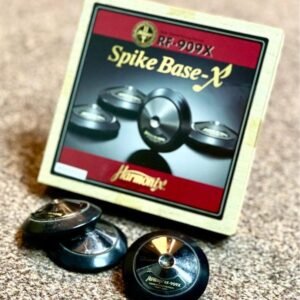
Harmonix SYN 100 Spikes and RF909x Spike Base
• Product Overview – Harmonix SYN 100 Spikes and RF909x Spike Base, released in the mid-2000s, are vibration control accessories designed to optimize mechanical grounding, resonance dissipation, and tonal balance in high-end audio systems.
• Tuning Philosophy – Developed using Harmonix’s tuning-based approach, the combination controls energy flow rather than fully isolating components, preserving musicality, timing accuracy, and natural harmonic structure.
• System Enhancement – Harmonix SYN 100 Spikes and RF909x Spike Base improve focus, bass articulation, and soundstage stability when used under loudspeakers, racks, or electronics, especially in revealing high-resolution systems.
• Specifications – Precision-machined metal spikes with matched base interfaces, resonance-tuned materials, point-contact energy transfer, and compatibility with most speaker and rack threaded inserts for universal audiophile applications.
• Dimensions – Individual spike height is approximately 25 mm, with RF909x bases measuring roughly 50 mm in diameter, allowing discreet placement while maintaining effective mechanical coupling.
• Weight – Each spike and base set weighs approximately 150–200 g, providing sufficient mass for stability while supporting controlled resonance behavior and consistent component grounding.
$ 1,405.54 -
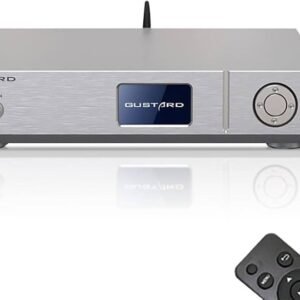
Gustard X26 Pro DAC
• Flagship DAC Architecture – The Gustard X26 Pro DAC, launched in early 2021, uses dual ESS9038PRO chips in fully balanced configuration to deliver exceptional transparency, ultra-low distortion, and reference-grade digital processing for demanding systems.
• Advanced Clocking System – Featuring Accusilicon femtosecond clocks and independent power regulation, the X26 Pro achieves impressively low jitter, improving imaging precision, micro-detail retrieval, and overall spatial coherence in complex recordings.
• Versatile Connectivity – The Gustard X26 Pro DAC supports USB, I²S, AES/EBU, coaxial, and optical inputs, with PCM up to 768 kHz and DSD512, ensuring compatibility with high-resolution sources and modern streaming transports.
• Robust Analog Output Stage – Its fully discrete, fully balanced Class A output stage provides strong drive, natural tonality, and excellent dynamic range, making the X26 Pro suitable for both preamps and direct power-amp integration.
• Dimensions – Measures approximately 330 mm (W) × 260 mm (D) × 65 mm (H), offering a compact yet substantial chassis designed for vibration control and thermal stability.
• Weight – Weighs around 5.8 kg, with its heavy aluminum enclosure enhancing durability, shielding, and noise suppression for cleaner digital-to-analog conversion.
$ 780.85Gustard X26 Pro DAC
$ 780.85 -

JBL Synthesis Project Array 1400
• High-Performance Overview – The JBL Synthesis Project Array 1400, launched around 2007, is a flagship floorstanding loudspeaker using a Bi-Radial horn and powerful low-frequency system to deliver dynamic, room-filling cinema-grade sound.
• Horn-Loaded Precision – The JBL Synthesis Project Array 1400 features a titanium compression driver and advanced horn geometry, providing exceptional clarity, wide dispersion, and precise imaging ideal for both music and home-theater environments.
• Deep, Controlled Bass – A massive 14-inch Neodymium woofer delivers authoritative low frequencies with excellent transient response, enabling the Project Array 1400 to handle demanding low-end material while maintaining accuracy and control.
• Ultra-High Output Capability – With high sensitivity and robust driver construction, the JBL Synthesis Project Array 1400 achieves reference-level dynamics, low distortion, and impactful realism even at elevated listening levels.
• Dimensions – Approx. 1,115 mm (H) × 508 mm (W) × 406 mm (D). Large cabinet volume supports deep bass extension and wide sound dispersion across medium to large rooms.
• Weight – Approx. 64 kg per speaker, providing exceptional mechanical stability and reducing cabinet resonance for cleaner, more accurate acoustic performance.
$ 6,871.51JBL Synthesis Project Array 1400
$ 6,871.51 -

JBL HP 520 Speakers
• High-Performance Design – The JBL HP 520 Speakers deliver dynamic, room-filling sound with impressive bass depth, refined midrange clarity, and excellent dispersion, making them ideal for audiophiles seeking a powerful yet balanced presentation.
• Acoustic Precision – Featuring advanced JBL driver engineering and a well-tuned cabinet, these speakers offer articulate imaging, smooth frequency response, and reliable performance across a wide range of musical genres and listening environments.
• Versatile System Matching – The JBL HP 520 Speakers pair effectively with solid-state or tube amplification, offering stable impedance behavior and strong efficiency, ensuring consistent performance across diverse hi-fi system setups.
• Robust Build Quality – Constructed with solid cabinetry and high-quality drivers, the JBL HP 520 Speakers provide durability, low resonance, and long-term performance ideal for serious home audio enthusiasts.
• Dimensions – Each speaker measures approximately 680 mm (H) × 380 mm (W) × 300 mm (D), offering a substantial footprint while remaining manageable for medium to large listening rooms.
• Weight – Each unit weighs around 18–20 kg, providing cabinet stability and reducing unwanted vibration for improved sonic accuracy.
$ 546.60JBL HP 520 Speakers
$ 546.60
