
-
LFD NCSE Mk. III Integrated Amplifier
• Overview – The LFD NCSE Mk. III Integrated Amplifier, released in 2015, is a solid-state integrated amplifier featuring pure analogue preamplification and minimalist circuit design, delivering highly musical performance without DAC or digital circuitry.
• Minimalist Circuit Philosophy – Designed by Dr. Richard Bews, the amplifier eliminates unnecessary components and feedback paths, allowing the LFD NCSE Mk. III Integrated Amplifier to achieve exceptional transparency, natural timing, and remarkably low noise.
• Pure Analogue Signal Path – The LFD NCSE Mk. III Integrated Amplifier is known for its short signal path and hand-selected components, producing lifelike midrange texture, dynamic agility, and an organic presentation highly valued by audiophiles.
• Specifications – Solid-state integrated amplifier, approximately 70W per channel into 8 ohms, high-current output stage, wide bandwidth design, line-level inputs only, ultra-short signal path architecture for minimal signal degradation.
• Dimensions – Approximately 445 mm (W) × 115 mm (H) × 300 mm (D), housed in a minimalist aluminium chassis designed to reduce resonance and maintain stable thermal performance.
• Weight – Approximately 10–12 kg, reflecting its substantial internal transformer, carefully selected discrete components, and rigid enclosure construction.
For Prices LoginLFD NCSE Mk. III Integrated Amplifier
For Prices Login -

Aracraft Tedius AL100ND
• Product Overview – Aracraft Tedius AL100ND, released in the early 2000s, is a solid-state Class AB integrated amplifier emphasizing high-current delivery and minimalist line-level preamplification without DAC or phono stages.
• Amplifier Topology – Built around a high-bias Class AB output stage and robust linear power supply, the design prioritizes stability, low distortion, and consistent control across varying loudspeaker loads.
• Sonic Character – Aracraft Tedius AL100ND is known for its neutral tonal balance, excellent midrange clarity, and tight bass articulation, appealing to listeners who value transparency and precise timing.
• Specifications – Rated around 100 watts per channel into 8 ohms, with high damping factor, wide bandwidth, and low total harmonic distortion for accurate reproduction across complex musical passages.
• Dimensions – Approx. 430 mm (W) × 150 mm (H) × 400 mm (D), using a rigid chassis and internal layout designed to minimize vibration and electromagnetic interference.
• Weight – Approximately 18–20 kg, reflecting a substantial power transformer, large reservoir capacitors, and solid mechanical construction for long-term electrical and thermal stability.
For Prices LoginAracraft Tedius AL100ND
For Prices Login -
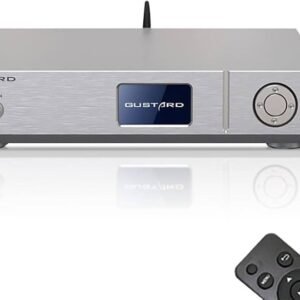
Gustard X26 Pro DAC
• Flagship DAC Architecture – The Gustard X26 Pro DAC, launched in early 2021, uses dual ESS9038PRO chips in fully balanced configuration to deliver exceptional transparency, ultra-low distortion, and reference-grade digital processing for demanding systems.
• Advanced Clocking System – Featuring Accusilicon femtosecond clocks and independent power regulation, the X26 Pro achieves impressively low jitter, improving imaging precision, micro-detail retrieval, and overall spatial coherence in complex recordings.
• Versatile Connectivity – The Gustard X26 Pro DAC supports USB, I²S, AES/EBU, coaxial, and optical inputs, with PCM up to 768 kHz and DSD512, ensuring compatibility with high-resolution sources and modern streaming transports.
• Robust Analog Output Stage – Its fully discrete, fully balanced Class A output stage provides strong drive, natural tonality, and excellent dynamic range, making the X26 Pro suitable for both preamps and direct power-amp integration.
• Dimensions – Measures approximately 330 mm (W) × 260 mm (D) × 65 mm (H), offering a compact yet substantial chassis designed for vibration control and thermal stability.
• Weight – Weighs around 5.8 kg, with its heavy aluminum enclosure enhancing durability, shielding, and noise suppression for cleaner digital-to-analog conversion.
For Prices LoginGustard X26 Pro DAC
For Prices Login
