
-
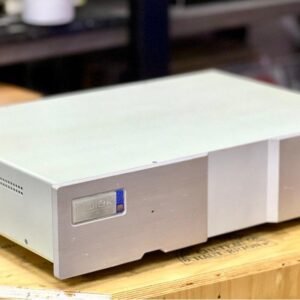
Isotek Sigma Power Conditioner
• Overview – The Isotek Sigma Power Conditioner, released in 2015, is a solid-state mains conditioning component engineered to dramatically reduce electrical noise while maintaining unrestricted current delivery for high-performance audio systems.
• Power Architecture – Built around IsoTek’s advanced delta-filtering topology, the Isotek Sigma Power Conditioner isolates connected components, eliminating differential and common-mode noise while preventing cross-contamination between digital sources and high-current amplifiers.
• Sonic Performance – By lowering the system noise floor, the Isotek Sigma Power Conditioner improves bass articulation, dynamic contrast, image stability, and low-level resolution, especially noticeable in revealing reference-grade analogue and digital systems.
• Specifications – Rated for high-current audio use, featuring multiple individually filtered outlets, star-earthed grounding, internal copper bus bars, RFI/EMI suppression, and surge protection without dynamic compression or current limiting.
• Dimensions – Measures approximately 445 mm (W) × 150 mm (H) × 350 mm (D), designed for standard hi-fi racks while allowing sufficient ventilation and cable clearance for complex multi-component installations.
• Weight – Weighs roughly 15 kg, reflecting substantial internal filtering networks, shielding, and mechanical damping that contribute to stable, resonance-free operation and long-term electrical reliability.
For Prices LoginIsotek Sigma Power Conditioner
For Prices Login -

Isotek Evo3 Power Conditioner
• Product Overview – The Isotek Evo3 Power Conditioner (2016) is a solid-state mains conditioning solution designed to reduce electrical noise, improve current delivery, and enhance overall system clarity in high-resolution hi-fi setups.
• Filtering Topology – Employing IsoTek’s multi-stage delta filter network, the Isotek Evo3 Power Conditioner effectively removes both common-mode and differential-mode noise while preventing cross-contamination between connected audio components.
• Sonic Improvements – Users typically experience lower noise floor, improved micro-detail, tighter bass control, and greater soundstage depth, especially when used with sensitive digital sources and analogue front-end components.
• Specifications – Features high-current audio outlets, internal copper bus bars, star-earthed grounding, RFI/EMI suppression, and surge protection, all engineered to avoid current compression and preserve amplifier dynamics.
• Dimensions – Measures approximately 445 mm wide × 90 mm high × 305 mm deep, sized to integrate easily into standard hi-fi racks or equipment shelves without compromising ventilation or cable management.
• Weight – Weighs roughly 8 kg, reflecting robust internal filtering components, shielding, and mechanical construction designed to ensure stability, durability, and long-term performance consistency.
For Prices LoginIsotek Evo3 Power Conditioner
For Prices Login -

Apogee Stage Speakers
• Product Overview – The Apogee Stage Speakers, released circa 1990, are full-range planar ribbon loudspeakers designed for high-resolution, low-distortion playback, delivering the open, fast transient response Apogee is renowned for.
• Ribbon Loudspeaker Performance – Featuring true ribbon midrange and tweeter elements, these speakers deliver lightning-fast transients, exceptional clarity, and expansive soundstaging that rewards high-quality amplification and careful system matching.
• Design & Sonic Character – The Apogee Stage Speakers use a dipole radiation pattern with large ribbon surfaces, producing natural tonal balance, deep image layering, and lifelike vocal reproduction unmatched by conventional dynamic driver designs.
• Specifications – Nominal impedance is approximately 3–4 ohms with sensitivity around 86 dB, requiring high-current amplifiers capable of stable low-impedance drive to unlock their full dynamic and tonal potential.
• Dimensions – Each speaker measures approximately 1220 mm (H) × 560 mm (W) × 60 mm (D), with a slim vertical profile that still demands adequate floor space and thoughtful room placement.
• Weight – Each speaker weighs roughly 32 kg, reflecting the substantial ribbon assemblies, rigid frame construction, and damping required for mechanical stability and accurate ribbon driver operation.
For Prices LoginApogee Stage Speakers
For Prices Login -

Harmonix XDC-2 Power Cable (1.5m)
• Overview – Harmonix XDC-2 Power Cable, released in the early 2000s, is a Japanese audiophile-grade power cable designed to prioritise tonal naturalness, musical flow, and noise reduction over sheer current delivery.
• Design Philosophy – Developed using Harmonix’s tuning-by-ear approach, the cable focuses on resonance control, material synergy, and vibration damping to achieve a relaxed, organic presentation across analog and digital components.
• Sonic Performance – Harmonix XDC-2 Power Cable is renowned for smooth treble, rich midrange tonality, and coherent timing, making it especially attractive for tube systems and musically voiced solid-state equipment.
• Specifications – High-purity copper conductors, moderate gauge design, carefully selected dielectric materials, effective mechanical damping, and high-quality connectors optimized for stable contact and consistent AC power transfer.
• Dimensions – Commonly supplied in approximately 1.5 m length, featuring a flexible outer jacket that allows easy routing while maintaining consistent electrical and mechanical characteristics.
• Weight – Approximately 0.9 kg per cable, reflecting dense conductor materials and internal damping without excessive stiffness or stress on component IEC sockets.
For Prices LoginHarmonix XDC-2 Power Cable (1.5m)
For Prices Login -
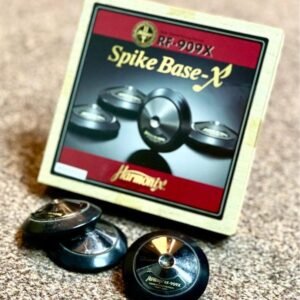
Harmonix SYN 100 Spikes and RF909x Spike Base
• Product Overview – Harmonix SYN 100 Spikes and RF909x Spike Base, released in the mid-2000s, are vibration control accessories designed to optimize mechanical grounding, resonance dissipation, and tonal balance in high-end audio systems.
• Tuning Philosophy – Developed using Harmonix’s tuning-based approach, the combination controls energy flow rather than fully isolating components, preserving musicality, timing accuracy, and natural harmonic structure.
• System Enhancement – Harmonix SYN 100 Spikes and RF909x Spike Base improve focus, bass articulation, and soundstage stability when used under loudspeakers, racks, or electronics, especially in revealing high-resolution systems.
• Specifications – Precision-machined metal spikes with matched base interfaces, resonance-tuned materials, point-contact energy transfer, and compatibility with most speaker and rack threaded inserts for universal audiophile applications.
• Dimensions – Individual spike height is approximately 25 mm, with RF909x bases measuring roughly 50 mm in diameter, allowing discreet placement while maintaining effective mechanical coupling.
• Weight – Each spike and base set weighs approximately 150–200 g, providing sufficient mass for stability while supporting controlled resonance behavior and consistent component grounding.
For Prices Login -

Marantz 1072
• Marantz 1072 Overview – The Marantz 1072, released in 1977, is a solid-state Class A/B integrated amplifier featuring built-in preamplification and the classic Marantz warm tonal signature, delivering smooth, musical performance for vintage audio enthusiasts.
• Classic Marantz Sound – Known for its rich midrange, fluid presentation, and non-fatiguing character, the Marantz 1072 offers excellent synergy with vintage and modern speakers, producing engaging sound with timeless musicality.
• Robust Solid-State Engineering – With high-quality transistors, stable power delivery, and Marantz’s renowned circuit philosophy, the 1072 maintains low noise, dependable operation, and strong dynamic expression across varied listening genres.
• Vintage Build Quality – The Marantz 1072 features a rigid chassis, precision rotary controls, and classic brushed-aluminum styling, appealing to collectors seeking reliable long-term performance and authentic 1970s design.
• Dimensions – Approx. 440 mm (W) × 126 mm (H) × 345 mm (D), sized to fit standard hi-fi shelving while maintaining proper airflow for stable vintage operation.
• Weight – Roughly 10.5 kg, supported by solid internal componentry and transformers that contribute to its stable, full-bodied sonic character.
For Prices LoginMarantz 1072
For Prices Login -
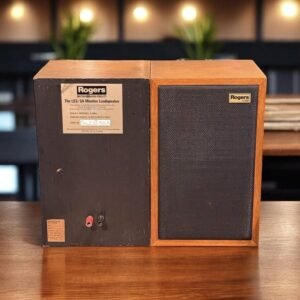
Rogers LS3/5A
• Rogers LS3/5A Overview – The Rogers LS3/5A, originally released in the mid-1970s for BBC broadcast use, is a legendary compact monitor known for its natural midrange, superb vocal clarity, and unmatched nearfield accuracy.
• BBC-Engineered Midrange Purity – Designed to reproduce speech and acoustic instruments with lifelike realism, the LS3/5A delivers exceptional tonal accuracy, refined articulation, and precise imaging unmatched by modern small monitors.
• Controlled and Coherent Presentation – The Rogers LS3/5A offers a warm, balanced character with smooth treble and tightly controlled bass, making it ideal for small to medium rooms and critical close-range listening.
• Classic Build and Legacy Craftsmanship – Featuring KEF T27 tweeters, B110 midbass drivers, and complex 13-element crossovers, each LS3/5A is hand-built to exact BBC specifications for consistent, reference-grade performance.
• Dimensions – Approx. 305 mm (H) × 190 mm (W) × 165 mm (D), maintaining the compact, sealed-box form factor ideal for accurate desktop or stand-mount placement.
• Weight – Around 4.9–5.3 kg per speaker depending on production era, contributing to cabinet rigidity and reduced resonance for cleaner midrange reproduction.
For Prices LoginRogers LS3/5A
For Prices Login -

Rogers Studio 1A
• Loudspeaker Overview – The Rogers Studio 1A, released in the mid-1980s, is a classic British 2-way monitor known for its natural midrange, balanced neutrality, and accurate studio-inspired performance suitable for both audiophile and professional use.
• BBC-Style Tuning – Designed with Rogers’ broadcast heritage, the Studio 1A offers excellent vocal articulation, smooth treble behavior, and cohesive imaging, preserving the musicality and tonal realism associated with the BBC school of loudspeaker design.
• Controlled Bass Performance – Using a well-damped cabinet and precision-matched bass driver, the Rogers Studio 1A provides tight, articulate low frequencies that integrate cleanly into small and medium-sized rooms without excessive boominess.
• High-Quality Construction – With rigid cabinet walls, refined crossover components, and careful driver matching, the Studio 1A delivers long-term reliability and consistent performance, reflecting the meticulous engineering of classic Rogers loudspeakers.
• Dimensions – Approx. 560 mm (H) × 275 mm (W) × 305 mm (D). A compact monitor design optimized for stand-mount use to achieve proper bass balance and imaging height.
• Weight – Approx. 12–14 kg per speaker, offering solid mass for cabinet stability and reduced resonance, supporting accurate midrange and cleaner transients.
For Prices LoginRogers Studio 1A
For Prices Login