
-

Apogee Stage Speakers
• Product Overview – The Apogee Stage Speakers, released circa 1990, are full-range planar ribbon loudspeakers designed for high-resolution, low-distortion playback, delivering the open, fast transient response Apogee is renowned for.
• Ribbon Loudspeaker Performance – Featuring true ribbon midrange and tweeter elements, these speakers deliver lightning-fast transients, exceptional clarity, and expansive soundstaging that rewards high-quality amplification and careful system matching.
• Design & Sonic Character – The Apogee Stage Speakers use a dipole radiation pattern with large ribbon surfaces, producing natural tonal balance, deep image layering, and lifelike vocal reproduction unmatched by conventional dynamic driver designs.
• Specifications – Nominal impedance is approximately 3–4 ohms with sensitivity around 86 dB, requiring high-current amplifiers capable of stable low-impedance drive to unlock their full dynamic and tonal potential.
• Dimensions – Each speaker measures approximately 1220 mm (H) × 560 mm (W) × 60 mm (D), with a slim vertical profile that still demands adequate floor space and thoughtful room placement.
• Weight – Each speaker weighs roughly 32 kg, reflecting the substantial ribbon assemblies, rigid frame construction, and damping required for mechanical stability and accurate ribbon driver operation.
For Prices LoginApogee Stage Speakers
For Prices Login -
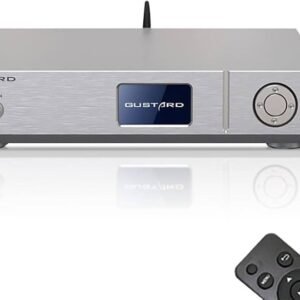
Gustard X26 Pro DAC
• Flagship DAC Architecture – The Gustard X26 Pro DAC, launched in early 2021, uses dual ESS9038PRO chips in fully balanced configuration to deliver exceptional transparency, ultra-low distortion, and reference-grade digital processing for demanding systems.
• Advanced Clocking System – Featuring Accusilicon femtosecond clocks and independent power regulation, the X26 Pro achieves impressively low jitter, improving imaging precision, micro-detail retrieval, and overall spatial coherence in complex recordings.
• Versatile Connectivity – The Gustard X26 Pro DAC supports USB, I²S, AES/EBU, coaxial, and optical inputs, with PCM up to 768 kHz and DSD512, ensuring compatibility with high-resolution sources and modern streaming transports.
• Robust Analog Output Stage – Its fully discrete, fully balanced Class A output stage provides strong drive, natural tonality, and excellent dynamic range, making the X26 Pro suitable for both preamps and direct power-amp integration.
• Dimensions – Measures approximately 330 mm (W) × 260 mm (D) × 65 mm (H), offering a compact yet substantial chassis designed for vibration control and thermal stability.
• Weight – Weighs around 5.8 kg, with its heavy aluminum enclosure enhancing durability, shielding, and noise suppression for cleaner digital-to-analog conversion.
For Prices LoginGustard X26 Pro DAC
For Prices Login -
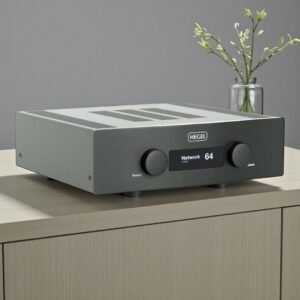
Hegel H390 Integrated Amplifier
• Hegel H390 Integrated Amplifier – A high-current Class AB design delivering exceptional control, low distortion and dynamic authority, offering reference-level performance for demanding loudspeakers and advanced audiophile systems.
• SoundEngine2 & Digital Architecture – Featuring Hegel’s SoundEngine2 error-cancellation technology, dual mono design and advanced DAC implementation, the Hegel H390 Integrated Amplifier achieves ultra-low noise, remarkable resolution and highly accurate musical timing.
• Connectivity & System Flexibility – With DLNA/UPnP streaming, AirPlay, Roon Ready support, coaxial/optical inputs, USB, analogue RCA and XLR, the Hegel H390 Integrated Amplifier integrates effortlessly into complex digital ecosystems with stable, high-bandwidth signal management.
• Power Delivery & Listening Behaviour – Delivering 250W per channel into 8 ohms with high damping factor, the Amplifier provides tight bass grip, expansive soundstage layering and effortless dynamic scaling across all playback levels.
• Product Dimensions – The Hegel H390 Integrated Amplifier measures 430 mm (W) × 115 mm (H) × 445 mm (D), offering a substantial yet rack-friendly footprint designed for optimal cooling and mechanical stability.
• Product Weight – Weighing approximately 20.5 kg, the Amplifier benefits from a rigid chassis and large toroidal transformer, improving noise isolation, transient control and overall sonic refinement.
For Prices LoginHegel H390 Integrated Amplifier
For Prices Login