An Afternoon with the Master Fidelity NADAC D
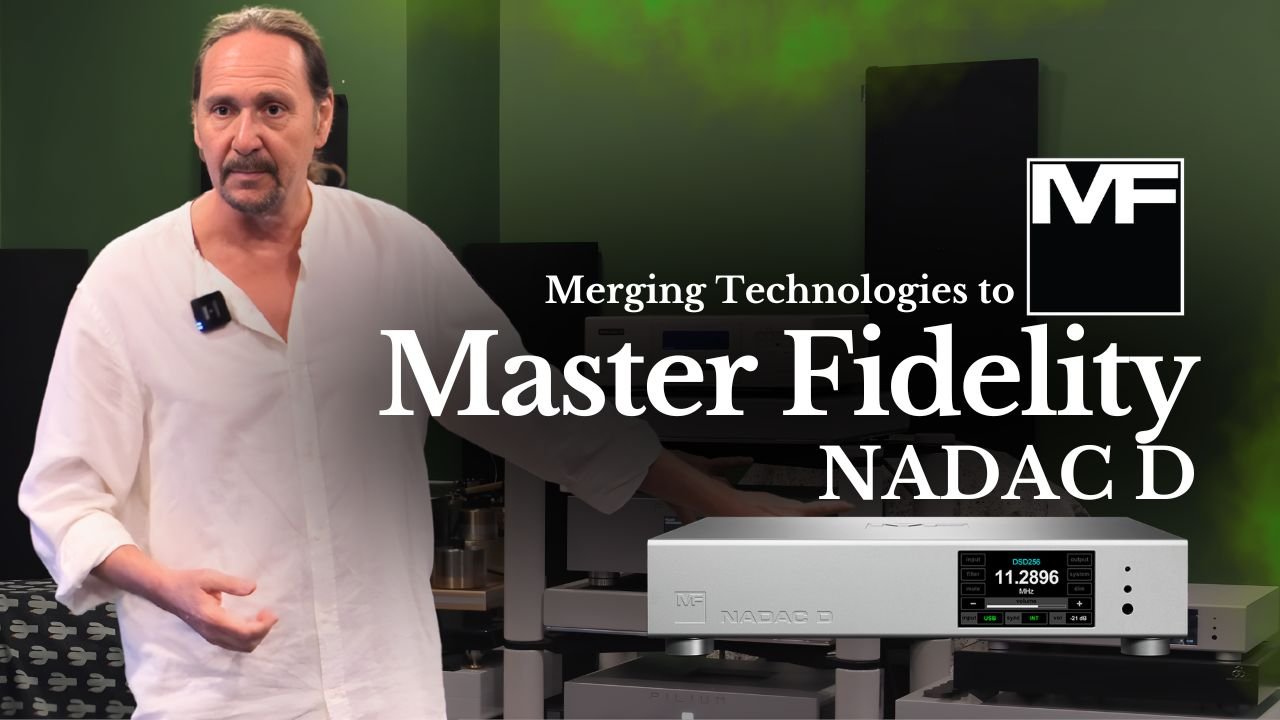
Singapore’s Adelphi building has long been a gathering point for the local audiophile community. Tucked within its corridors are listening rooms where ideas, music, and technology intersect. On 28 February 2026, I attended one such gathering hosted by Simon of Simplicity Control and presented by Dominique Brulhart from Merging Technologies (who was dropping by after a vacation in Vietnam). A small group of enthusiasts came together to experience the Master Fidelity NADAC D digital-to-analogue converter.
Rather than a conventional product demonstration, the afternoon unfolded more like a discussion about the deeper challenges of digital audio — timing, conversion accuracy, and the elusive goal of reproducing recorded music as faithfully as possible.
For many of us present, it was also a chance to hear how far modern digital design has progressed.
From Studio Technology to Audiophile Systems
The NADAC lineage has roots in the professional recording world. The original NADAC platform was associated with the engineers behind Merging Technologies, a Swiss company known for high-resolution recording systems used in professional studios. Over time, development of the consumer NADAC concept continued under Master Fidelity, a Canadian company focused on pushing the boundaries of digital-to-analogue conversion.
That heritage is important because the design philosophy behind the NADAC D is fundamentally studio-driven: the goal is not simply to make digital audio sound impressive, but to reproduce the signal as close as possible to the original master recording.
During the session, Simon and Dominique walked us through the rationale for the design. In high-end digital audio, the conversion stage — the point where digital data becomes analogue signal — remains one of the most complex and debated areas of engineering.
The NADAC D approaches this challenge differently from most DACs currently on the market.
The Idea Behind a True 1-Bit DAC
At the heart of the NADAC D lies a custom one-bit DAC architecture, implemented through a proprietary application-specific integrated circuit (ASIC).
Most modern DACs rely on commercially available multi-bit conversion chips from manufacturers such as ESS or AKM. These chips offer excellent performance and are widely used across the industry. However, the NADAC D takes a more specialised route by using a dedicated chip designed specifically for this application.
The concept behind a true 1-bit DAC is relatively straightforward in theory.
A single-bit conversion system can achieve extremely high linearity because it avoids many of the resistor-matching errors that occur in multi-bit DAC designs. In practice, however, it is extremely difficult to implement successfully. A one-bit system requires exceptionally precise clocking and algorithm design to maintain stability and low noise.
This is one of the reasons why fully custom one-bit DAC chips have been rare in modern audio design.
Master Fidelity’s solution was to develop a dedicated ASIC chip, optimized specifically for audio conversion rather than relying on general-purpose programmable logic.
Timing: The Often Overlooked Factor
One topic that generated considerable discussion during the session was jitter, a phenomenon that affects the timing accuracy of digital audio signals.
In simple terms, digital audio is not only about the numerical value of each sample — it is also about when each sample arrives. If timing fluctuates, even slightly, it can introduce subtle distortions that affect imaging, spatial realism, and micro-detail.
To address this, the NADAC D incorporates a sophisticated clock architecture with extremely low jitter performance. The system can also accept an external 10 MHz master clock, allowing synchronization with dedicated clock devices for even greater timing accuracy.
Internally, the DAC also employs specialized clock-recovery systems and power-supply regulation designed to minimise noise and timing instability.
While these details can sound highly technical, the purpose is straightforward: reduce timing errors so that the analogue waveform reconstructed from the digital signal remains as faithful as possible to the original recording.
Listening in Context
Technical discussions are fascinating, but the ultimate question in any audio demonstration is simple: how does it sound?
During the listening session, several tracks were played across different genres. What struck me most was not a sense of exaggerated detail, but rather a feeling of effortless transparency.
Spatial information appeared well organised, with stable imaging and convincing depth. Quiet passages emerged from a dark background, and small dynamic changes seemed easier to perceive.
What stood out most was the overall sense of coherence. The presentation felt relaxed and natural rather than analytical — a quality many audiophiles associate with well-implemented digital playback.
Of course, listening impressions are always influenced by the entire system and room environment. Nevertheless, the session offered an interesting demonstration of how modern digital design continues to evolve.
Why Events Like This Matter
Beyond the equipment itself, what made the afternoon memorable was the exchange of ideas.
Hi-Fi gatherings like this provide a rare opportunity for enthusiasts to discuss design philosophies directly with the people behind the products. Instead of simply reading specifications, we get to explore the thinking that shapes modern audio engineering.
For the Singapore audiophile community, events hosted in places like The Adelphi play an important role in sustaining that culture of curiosity.
High-end audio is often misunderstood as a hobby centred purely around equipment. But afternoons like this remind us that it is really about something deeper — understanding how music travels from the recording studio to our listening rooms, and how each technological decision influences what we ultimately hear.
And sometimes, all it takes is a quiet listening room, a group of curious listeners, and a well-designed DAC to spark that conversation.